
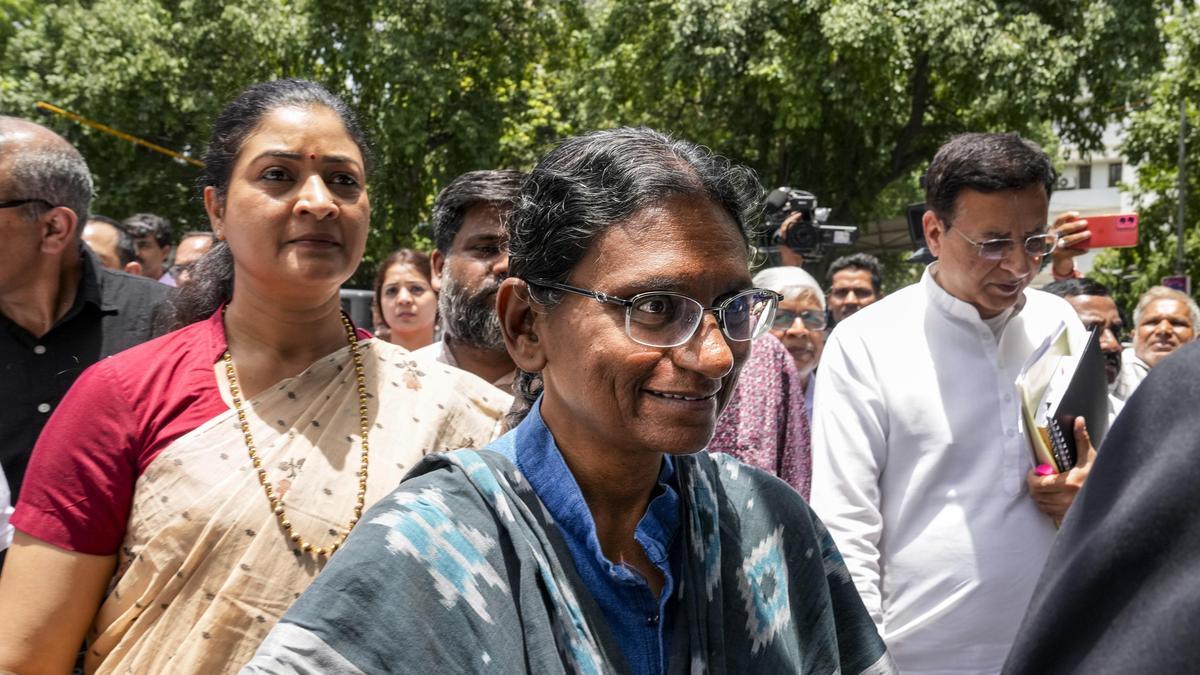
A Bench of Justices Prashant Kumar Mishra and A.S. Chandurkar observed that Article 329 of the Constitution bars judicial interference once the nomination of a candidate has been rejected by the returning officer
Whenever an attempt has been made to invoke the jurisdiction of this Court under Article 32, or that of the High Courts under Article 226, during the process of elections, this Court has repeatedly declined interference, having regard to the constitutional mandate contained in Article 329(b) of the Constitution,” the Bench said.
Observing that the appropriate remedy lay elsewhere, the Bench added, “…if this petition is entertained, this court would be reading some principle which is not provided under Article 329 of the Constitution.”
The Bench, however, clarified that its observations on the rejection of Ms. Natarajan’s nomination would not prejudice any election petition that may be instituted before the jurisdictional High Court.
Patent error
During the hearing, senior advocate Abhishek Manu Singhvi, appearing for Ms. Natarajan, argued that the case warranted judicial interference as the rejection of his client’s nomination suffered from a “patent error”. He also questioned the Election Commission’s decision to proceed with the declaration of results on Thursday (June 11, 2026) despite the top court being cognisant of the matter.
Look at the conduct. Your Lordships listed the matter today, and they declared the results yesterday. She is only seeking an opportunity to contest. Let her fight and lose. She is only standing for election,” he said.
Mr. Singhvi further pointed out that the poll body was yet to decide the Congress’ representation challenging the returning officer’s decision to reject Ms. Natarajan’s nomination. “The Election Commission decides not to decide, the conduct is reprehensible. It does not discharge its constitutional duty,” he submitted.
The Bench, however, questioned whether any judicial intervention was permissible at this stage once the returning officer had rejected a candidate’s nomination.
However erroneous the decision may be, once a nomination is rejected, the remedy ordinarily lies elsewhere. Is there any judgment of this Court where we have interfered at that stage?” the Bench asked.
‘Not a fundamental right’
Senior advocate Mukul Rohatgi, appearing for the three BJP Rajya Sabha candidates from Madhya Pradesh, questioned the maintainability of the writ petition. He argued that the right to contest an election is a statutory right and not a fundamental right and, therefore, cannot be enforced through a petition under Article 32 of the Constitution.
Meanwhile, BJP candidates Tarun Chugh, Rajneesh Agrawal and Mahesh Kewat were declared elected unopposed to the three Rajya Sabha seats from the State on Thursday.
Ms. Natarajan’s nomination was challenged by Mr. Kewat and BJP State general secretary Rahul Kothari, who alleged that she had failed to disclose details of a criminal case pending before a court in Hyderabad in her election affidavit.
Accepting the objection, the Returning Officer held that Ms. Natarajan’s affidavit was incomplete as it did not disclose a notice issued to her by a Hyderabad court in October 2025. In his June 9 order, he further held that the Congress leader had submitted an incomplete Form 26 affidavit with her nomination papers and had “concealed material facts” relating to the court proceedings.

Hyderabad: Brain-dead businesswoman’s family donates her organs

Actress with back-to-back Telugu flops may leave Hyderabad
Hyderabad: Brain-dead businesswoman’s family donates her organs
Actress with back-to-back Telugu flops may leave Hyderabad
Jamia Nizamia files complaint against Hyderabad local news channel
Telangana CEO Directs BLOs to Clear Pending SIR Cases