
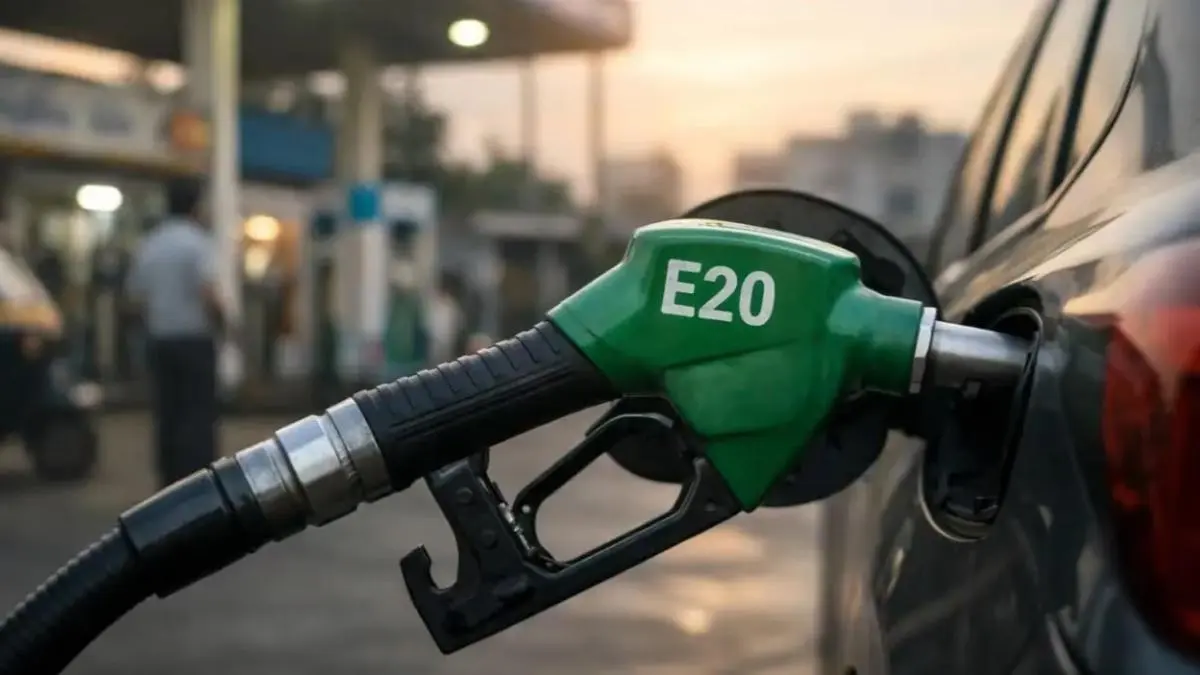
New Delhi, July 10, 2026: The Central government has acknowledged that the use of E20 petrol may reduce fuel efficiency by approximately 3–5% in certain vehicles. However, it defended India’s ethanol-blending programme, stating that its broader environmental, economic and energy-security benefits outweigh the relatively small decline in mileage.
E20 is a fuel mixture containing 20% ethanol and 80% petrol. The government has promoted its nationwide use as part of an effort to reduce India’s dependence on imported crude oil, support domestic ethanol production and lower carbon emissions from the transport sector.
The Ministry of Petroleum
and Natural Gas said that the effect of E20 on mileage may differ depending on the vehicle’s design, engine technology, age and compatibility with ethanol-blended fuel. Some vehicles, particularly those not specifically optimised for E20, may experience a moderate reduction in fuel economy.
The government explained that ethanol has a lower energy content than conventional petrol. As a result, a vehicle may need to consume slightly more fuel to travel the same distance. This difference in energy content is one of the reasons behind the estimated 3–5% decline in mileage in some vehicles.
Despite concerns raised by motorists, the government rejected general claims that E20 petrol causes widespread engine damage. It stated that the fuel had undergone extensive evaluation before being introduced on a large scale. The testing reportedly covered engine durability, corrosion resistance, fuel-system performance, material compatibility, emissions and overall drivability.
According to the government, E20 also provides certain performance advantages. Ethanol has a higher octane rating, which can improve resistance to engine knocking. The fuel may support smoother acceleration, better pickup and cleaner combustion, particularly in engines designed or optimised to use E20.
The government also highlighted
the environmental benefits of ethanol blending. Since ethanol is produced from renewable agricultural materials, its use can help reduce lifecycle greenhouse-gas emissions. Greater ethanol consumption may also create additional demand for agricultural products and provide economic opportunities for farmers and domestic ethanol producers.
Another major objective of the programme is to improve India’s energy security. The country imports a significant share of its crude-oil requirements, making it vulnerable to changes in international oil prices and global supply disruptions. Replacing a portion of petrol with domestically produced ethanol could reduce the country’s dependence on imported fuel and help conserve foreign exchange.
However, the E20 rollout has led to public debate. Some vehicle owners have complained about reduced mileage and expressed concern about the long-term impact of the fuel on older vehicles. Questions have also been raised regarding the limited availability of alternative fuels, such as E10 or petrol without ethanol, at filling stations.
Critics have further
questioned why E20 petrol is not cheaper for consumers despite the possible reduction in fuel efficiency. Reports indicate that ethanol-blended petrol may currently be more expensive to produce than conventional petrol under certain market conditions. The government, however, maintains that the programme should be evaluated on its long-term benefits rather than only on immediate production costs.
India achieved 10% ethanol blending in petrol ahead of its original schedule and later expanded the programme to reach the 20% blending target. The government has described this progress as an important step towards cleaner transportation, stronger domestic energy production and reduced dependence on fossil-fuel imports.
While acknowledging that some motorists may experience a small decline in mileage, the government maintains that E20 offers wider advantages through reduced oil imports, cleaner fuel use, improved energy security and support for the agricultural economy.
The issue continues to attract public attention, particularly regarding vehicle compatibility, fuel pricing, consumer choice and the long-term effects of E20 on older vehicles.

Hyderabad: Brain-dead businesswoman’s family donates her organs