
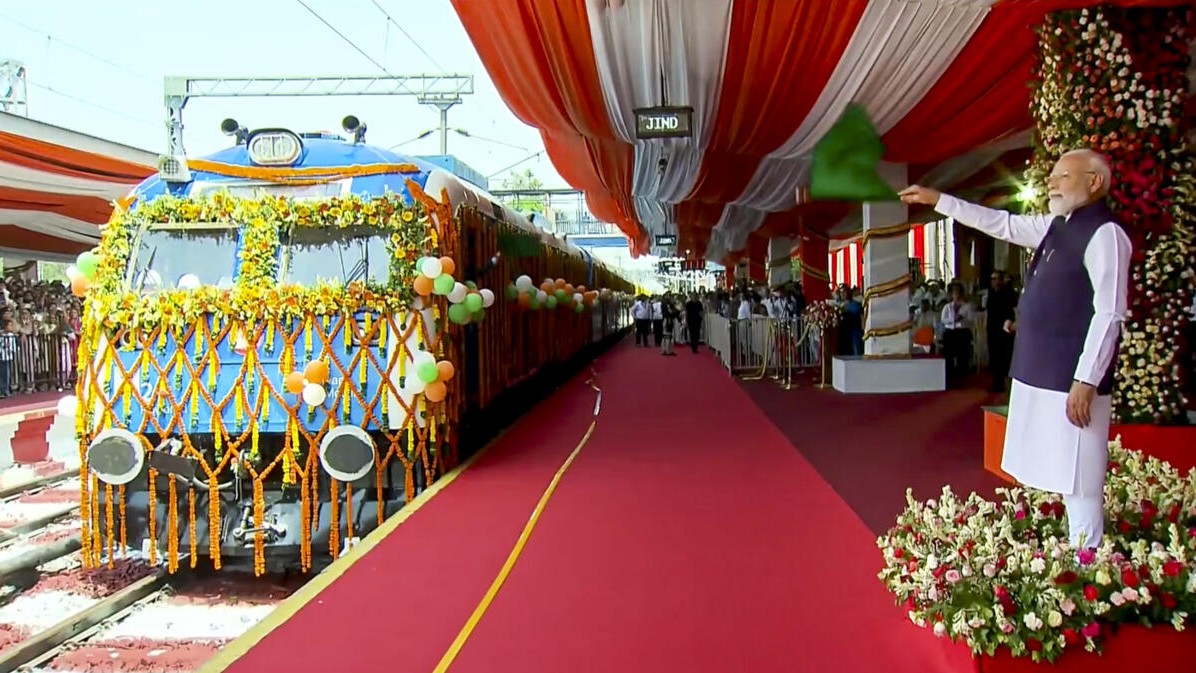
Jind, Haryana: Prime Minister Narendra Modi on Friday inaugurated India’s first hydrogen-powered train, marking a major milestone in the country’s transition towards clean and sustainable transportation. The train was flagged off from Jind railway station and will operate on the Jind–Sonipat route, making India one of the few countries in the world to introduce hydrogen-powered rail services.
The newly launched train
, known as NaMo Green Rail, has been developed using indigenous technology under the ‘Make in India’ initiative. It consists of two hydrogen-powered driving coaches and eight passenger coaches, with a seating and carrying capacity of around 2,600 passengers. The train is designed to reduce dependence on diesel-powered locomotives and promote environmentally friendly rail transport.
Unlike conventional diesel trains, the hydrogen-powered train generates electricity through a hydrogen fuel cell, where hydrogen combines with oxygen to produce power. The only by-product of this process is water vapour, making it a near-zero-emission mode of transportation. The initiative is expected to significantly reduce carbon emissions and contribute to India’s long-term clean energy goals.
Addressing the gathering after the inauguration, Prime Minister Modi described the launch as a historic achievement for Indian Railways and said the project reflects India’s commitment to innovation, self-reliance, and green technology. He stated that the hydrogen-powered train places Haryana and India on the global map of sustainable rail transport while strengthening the country’s efforts towards achieving net-zero carbon emissions by 2070.
During his visit, the Prime Minister
also inaugurated and laid the foundation stone for development projects worth around ₹14,700 crore across Haryana. These projects span sectors including railways, road infrastructure, urban development, energy, and public welfare, with the aim of boosting economic growth and improving connectivity across the state.
The hydrogen-powered train will initially operate on the 89-kilometre Jind–Sonipat route, where Indian Railways has also established a dedicated hydrogen production, storage, and refuelling facility. Officials said the route was selected after technical evaluations and is expected to serve as a pilot project before hydrogen technology is introduced on other suitable railway routes across the country.

Actress with back-to-back Telugu flops may leave Hyderabad