
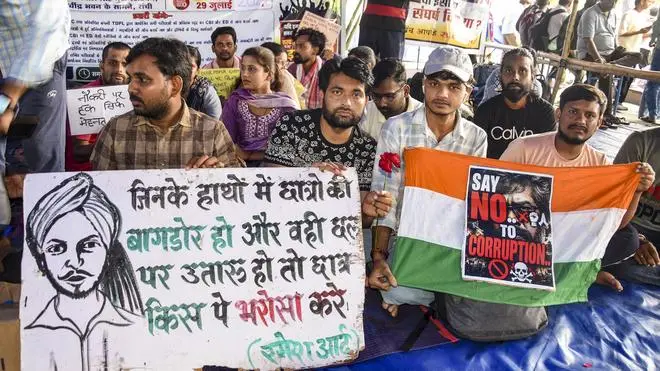
he growing anger among students in Jharkhand has brought the state’s political parties under renewed scrutiny. What began as frustration over examinations, recruitment and alleged irregularities has developed into a broader expression of dissatisfaction among young people who see government jobs and competitive examinations as crucial pathways to a stable future.
For thousands of students, the issue is not merely about one examination or one recruitment process. It is about the credibility of the system through which young people compete for limited government opportunities. Allegations of irregularities, delays and unfair practices can have serious consequences for candidates who spend years preparing for competitive examinations.
Students at the centre of the controversy
Jharkhand has a large population of young aspirants preparing for government examinations. In a state where public-sector employment is highly sought after, recruitment examinations carry enormous importance. Candidates invest considerable time and money in coaching, study materials and repeated attempts.
When an examination is surrounded by allegations of malpractice or procedural failures, the consequences extend beyond the immediate examination. Students can lose valuable years of preparation, while uncertainty over recruitment schedules can make it difficult to plan their careers.
The protests therefore reflect a deeper demand: students want recruitment procedures that are transparent, predictable and credible.
Why the issue has become political
Student anger inevitably creates a challenge for the political establishment. Opposition parties often use recruitment failures and examination controversies to criticise the government of the day. But the Jharkhand student movement also raises an uncomfortable question for the opposition: what did political parties do when they themselves were in power?
This is where the students’ anger becomes politically significant.
Young voters are increasingly unwilling to accept political arguments that focus only on which party is currently responsible. They want accountability across governments. If recruitment problems have existed for years, changing political leadership alone may not solve the structural weaknesses behind them.
The students’ demand is consequently broader than a partisan political campaign. They are asking whether governments—regardless of party—can provide a fair and dependable system for recruitment.
The employment question
Government employment has a special significance in Jharkhand. For many educated young people, public-sector jobs offer not only income but also social security and long-term stability.
At the same time, the number of candidates competing for these positions is much larger than the number of available vacancies. This makes every recruitment examination highly competitive.
Any allegation that an examination has been compromised therefore creates a sense of injustice among students. Candidates who have prepared honestly can feel that their efforts have been undermined by circumstances beyond their control.
This explains why examination controversies can quickly develop into large student movements.
Opposition parties face a credibility test
The protests also expose the limitations of conventional opposition politics.
Political parties can certainly raise questions about examination irregularities and demand action from the government. But students are increasingly looking beyond political speeches. They want concrete answers, institutional reforms and accountability.
That puts the opposition in a difficult position. Merely criticising the ruling party may not be enough. Opposition leaders must also explain what they would do differently if they returned to power.
For students, the central question is straightforward: Will the next government provide a recruitment system they can trust?

Hyderabad: Brain-dead businesswoman’s family donates her organs