
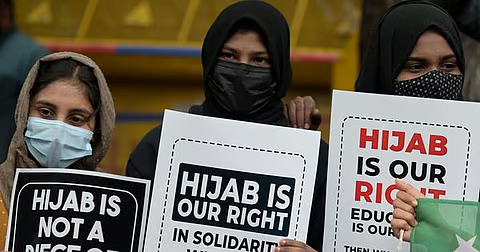
he Allahabad High Court has dismissed a petition filed by a minor Muslim student seeking permission to wear a hijab, or headscarf, along with the prescribed school uniform at a private school in Prayagraj. The court held that the student had not provided sufficient material to establish that wearing a headscarf was an essential religious practice of Islam.
The ruling has triggered a fresh debate over religious freedom, school dress codes and the rights of students. The All India Muslim Personal Law Board (AIMPLB) has indicated that it may challenge the decision before a higher court, arguing that hijab has an important place in Islamic religious practice.
What was the case about?
The petition was filed on behalf of a minor student of Tagore Public School in Attarsuiya, Prayagraj. The school is a private, unaided institution affiliated with the CBSE.
The student had studied at the same school from Class VI to Class X and, according to her petition, had worn a headscarf along with the school uniform during those years without facing an objection. After completing Class X, she sought admission to Class XI but wanted to continue wearing the headscarf. The dispute arose when the school insisted that students follow its prescribed dress code.
Through her mother, the student approached the Allahabad High Court and sought directions allowing her to wear the hijab with the prescribed uniform.
What did the Allahabad High Court decide?
A Division Bench comprising Justice J.J. Munir and Justice Indrajeet Shukla dismissed the petition.
The court said the student had not placed sufficient pleadings, authoritative religious material or other evidence to demonstrate that wearing a headscarf was an essential religious practice without which her faith would be jeopardised.
The judges also considered the school’s uniform policy. According to the court, when a dress code is applied uniformly, in good faith and without discrimination, the institution generally has the authority to prescribe what students should wear.
The court noted that uniforms can serve several purposes, including maintaining discipline, promoting equality among students, creating institutional identity and reducing visible distinctions between students of different backgrounds.
Previous permission to wear hijab was not considered a permanent right
One important aspect of the judgment was the student’s argument that she had previously worn the headscarf at the school without objection.
The court rejected the idea that this earlier practice automatically created a permanent legal right to continue wearing it. The judges said that the school’s earlier failure to object did not prevent it from enforcing its uniform policy later.
The court also pointed out that this was not a situation in which the school had suddenly changed its uniform for everyone. Rather, the dispute concerned the student’s request to add a headscarf to the existing uniform.
Hyderabad: Brain-dead businesswoman’s family donates her organs

3 Responses